

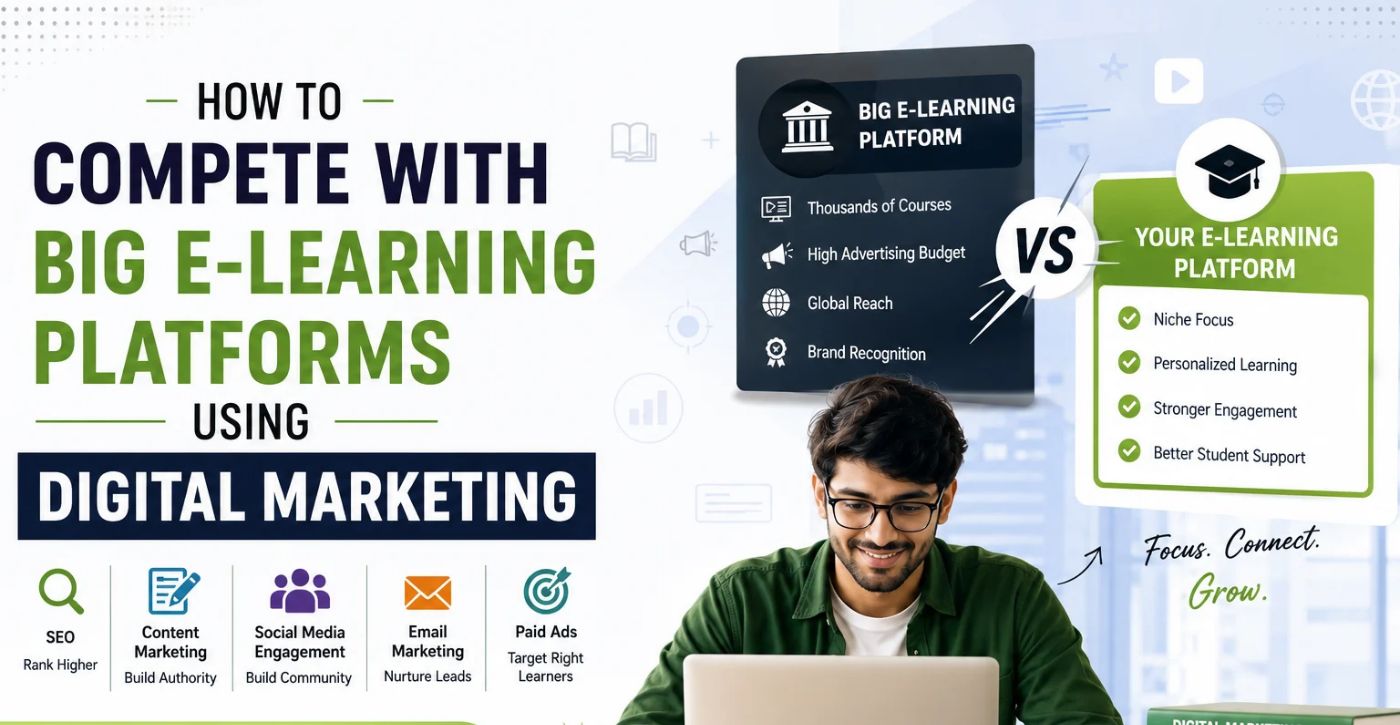
The e-learning industry has become highly competitive. Large platforms have extensive course libraries, strong brand recognition, large advertising budgets, and thousands of learners. For smaller e-learning businesses, training institutes, educators, and online course providers, competing with these established platforms can seem challenging.
However, having a smaller budget does not mean you cannot attract students. With the right digital marketing strategy for e-learning, smaller education brands can build visibility, reach specific audiences, establish trust, and compete effectively with larger platforms.
The key is not to compete with big e-learning companies on everything. Instead, focus on your unique strengths, understand your target students, and use digital marketing channels strategically.
1. Define a Specific Target Audience
Large e-learning platforms often target a broad audience. Smaller education businesses can gain an advantage by focusing on a specific group of learners.
Instead of promoting courses to everyone, identify who is most likely to benefit from your programs. Your audience could include college students, working professionals, job seekers, career changers, business owners, or learners interested in a particular technical skill.
A clearly defined audience makes it easier to create relevant content, advertisements, landing pages, and email campaigns.
For example, an institute offering technical training could target engineering graduates looking for job-oriented courses rather than competing for every online learner.
2. Build a Strong SEO Strategy
SEO for e-learning websites is one of the most cost-effective ways to compete with larger platforms over time.
Big platforms may dominate broad keywords such as “online courses” or “digital marketing course,” but smaller businesses can target long-tail and location-specific keywords with lower competition.
Examples include:
- Best online course for beginners in digital marketing
- Job-oriented technical courses for graduates
- Online certification courses for working professionals
- Best training institute for [specific skill] in [city]
- Affordable online courses with placement assistance
Create informative blog posts, course guides, FAQs, comparison articles, and educational resources around these keywords. Consistently publishing useful content can help your website attract organic traffic from people actively searching for solutions.
3. Create High-Quality Educational Content
Content marketing allows smaller e-learning businesses to demonstrate expertise without spending heavily on advertising.
Create content that answers the questions your target students are already asking. Blog articles, videos, tutorials, webinars, case studies, infographics, and downloadable guides can all support your digital marketing strategy.
For example, instead of only promoting a “Python Programming Course,” publish articles such as “What Can You Do With Python After Graduation?” or “Beginner’s Guide to Learning Python for a Career.” Useful content builds trust before a learner makes a purchase decision.
4. Use Social Media to Build a Community
Social media is an excellent opportunity for smaller e-learning brands because success is not always determined by advertising budget.
Platforms such as Instagram, YouTube, LinkedIn, and Facebook can be used to share educational content, student achievements, instructor tips, course insights, and industry updates.
Short videos can explain complex concepts in simple language. Student testimonials can demonstrate real experiences. Live sessions can allow potential learners to interact with instructors.
Rather than treating social media only as a promotional channel, use it to create a community around learning.
5. Showcase Student Success Stories
Trust is particularly important in online education. Potential students want to know whether a course can actually help them achieve their goals.
Student testimonials, reviews, project showcases, certifications, career journeys, and success stories can provide valuable social proof.
A strong case study could explain where a student started, what they learned, how they applied their skills, and what outcome they achieved.
Authentic stories can make a smaller education brand appear more credible and approachable than a large platform with a highly impersonal experience.
6. Focus on Personalized Learning Experiences
One major advantage smaller e-learning providers can have is personalization. Large platforms serve millions of learners, while smaller institutes may be able to provide more direct interaction with students. Use this advantage in your marketing.
Highlight features such as:
- Instructor interaction
- Live classes
- One-on-one guidance
- Personalized feedback
- Mentorship
- Doubt-clearing sessions
- Career counseling
- Small learning groups
When marketing emphasizes personal support rather than simply course quantity, students may see greater value in choosing a specialized provider.
7. Use Email Marketing for Lead Nurturing
Not every website visitor is ready to enroll immediately. Email marketing can help maintain relationships with potential students until they are ready to make a decision. Offer useful resources such as free guides, webinars, sample lessons, or course checklists in exchange for email subscriptions.
Then create an email sequence that provides educational content, answers common questions, shares student success stories, introduces instructors, and explains course benefits. Personalized email marketing can turn interested visitors into qualified leads and eventually enrolled students.
8. Invest in Targeted Paid Advertising
Smaller e-learning businesses do not necessarily need huge advertising budgets. The focus should be on targeting the right audience. Search advertising can reach people actively looking for courses, while social media advertising can target users based on interests, professional backgrounds, location, or behavior.
Instead of sending every advertisement to the homepage, create dedicated landing pages for individual courses and campaigns. A focused landing page should clearly explain the course benefits, curriculum, instructor expertise, learning format, testimonials, and next steps. Track campaign performance and gradually increase spending on advertisements that generate quality leads.
9. Use Local SEO as a Competitive Advantage
If your e-learning business also has a physical training center or serves students in a specific city, local SEO can provide an important advantage.
Optimize your website and business profiles for location-based searches. Create pages targeting relevant cities and regions, publish locally useful educational content, and encourage genuine student reviews.
For example, a specialized institute may have a better opportunity to rank for “best data analytics training institute in Hyderabad” than for a highly competitive national keyword such as “data analytics course.”
10. Differentiate Through Your Unique Value Proposition
The most important question is: Why should a student choose your platform instead of a large e-learning company? Your answer should be clear throughout your website and marketing campaigns.
Your competitive advantage could be expert instructors, live classes, career support, practical projects, industry-focused training, smaller batches, mentorship, regional expertise, flexible schedules, or specialized courses.
Do not try to copy the biggest platforms. Identify what you can deliver better and make that the center of your marketing strategy.
11. Collaborate With Educators and Industry Experts
Partnerships can help smaller e-learning brands expand their reach. Collaborate with industry professionals, educators, career coaches, influencers, and relevant content creators. Joint webinars, interviews, podcasts, guest articles, and educational videos can introduce your brand to new audiences.
These collaborations can also strengthen your authority and provide valuable content for SEO and social media.
12. Measure Your Digital Marketing Results
Digital marketing becomes more effective when decisions are based on data. Monitor metrics such as website traffic, keyword rankings, lead generation, email engagement, advertising performance, conversion rates, and course enrollments.
Understanding which channels generate the most valuable students allows you to allocate your marketing budget more effectively. For example, if organic search generates consistent course inquiries while a particular advertising campaign produces low-quality leads, you can focus more resources on SEO and improve or reduce the underperforming campaign.
[Also read: How Email Marketing Helps Educational Institutions Improve Student Retention]
Conclusion
Competing with big e-learning platforms does not require a massive marketing budget. Smaller education businesses can succeed by being more focused, relevant, personal, and responsive to their target audience.
A successful digital marketing strategy for e-learning should combine SEO, educational content, social media, email marketing, paid advertising, local search, testimonials, and a strong value proposition. Most importantly, every marketing activity should focus on helping learners make informed decisions.