


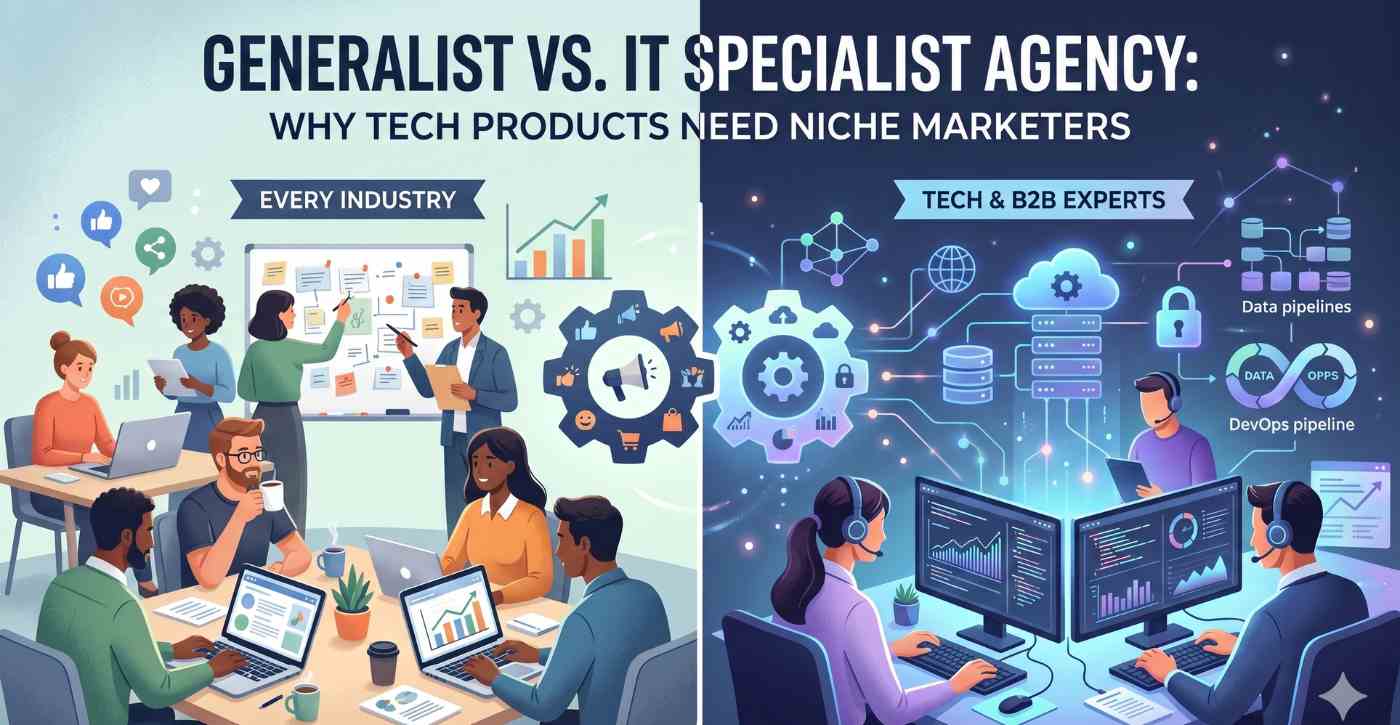
If you are a tech founder, CMO, or enterprise IT leader, you already know that marketing a B2B technology product is nothing like marketing a lifestyle brand or a local service business. Yet, when it comes to choosing a growth partner, many tech companies make the mistake of hiring a generalist digital marketing agency.
They are promised “creative campaigns” and “viral social media strategies,” only to end up with content that feels surface-level, misaligned with the IT buyer’s journey, and completely lacking technical depth.
When your product involves complex cloud architecture, cybersecurity protocols, or SaaS workflows, you don’t just need marketers. You need niche experts.
Here is a deep dive into the difference between a generalist and an IT specialist agency, and why niche marketing is non-negotiable for tech products.
1. The Knowledge Gap: Generalists Learn on Your Dime; Specialists Hit the Ground Running
When you hire a generalist agency, the first few months are usually spent trying to educate their account managers and writers on what your product actually does.
-
The Generalist Reality: A writer who spent yesterday drafting a blog post about organic skincare is suddenly tasked with writing about Kubernetes orchestration, zero-trust security models, or API integrations. The result? Fluffy, generic content that your highly technical audience can see right through.
-
The IT Specialist Advantage: A specialized IT marketing agency already speaks your language. They know the difference between an MSP (Managed Service Provider) and an MSSP (Managed Security Service Provider). They understand technical shorthand (ARR, SQLs, DevOps, ACV) and don’t need a three-month onboarding period just to grasp your core value proposition.
2. Navigating the Complex B2B Tech Buyer’s Journey
Generalist agencies excel at short, high-volume consumer sales cycles driven by impulse and emotion. However, the IT sector operates on an entirely different playing field. Tech buying involves multiple stakeholders, long evaluation periods, and massive budget considerations.
[Discovery] ──> [Technical Evaluation] ──> [CFO & Security Review] ──> [Deployment/Onboarding]
An IT specialist agency maps content and campaigns perfectly across this high-friction journey:
-
Top of Funnel (TOFU): Targeting IT managers experiencing specific operational bottlenecks (e.g., cloud cost optimization).
-
Middle of Funnel (MOFU): Providing deeply technical whitepapers, architectural diagrams, and feature comparison guides that satisfy the CTO or Solutions Architect.
-
Bottom of Funnel (BOFU): Creating security compliance checklists (SOC 2, GDPR) and hard-data ROI calculators to ease the minds of the CFO and CISO.
A generalist agency simply doesn’t possess the technical depth required to build content assets that satisfy a technical review board.
3. SEO That Targets Intent, Not Just Volume
A classic mistake generalist agencies make in tech SEO is chasing high-volume keywords that drive vanity traffic but zero conversions.
For example, a generalist might optimize your site for a broad term like “cloud software.” While it looks great on a monthly report because impressions spike, it brings in low-quality leads.
An IT specialized agency focuses on Product-Led SEO and high-intent, long-tail technical keywords. They will target phrases like “multi-cloud cost optimization tool for enterprise” or “automated patch management software for healthcare.” The search volume is lower, but the conversion rate and contract value (ACV) are exponentially higher.
4. E-E-A-T and Optimizing for Modern AI Search
With Google’s search algorithms heavily penalizing generic, surface-level content, E-E-A-T (Experience, Expertise, Authoritativeness, and Trustworthiness) is more critical than ever. Furthermore, as decision-makers increasingly turn to AI search engines (like ChatGPT, Perplexity, and Google AI Overviews) to research software solutions, generic content gets left behind.
AI models and human IT buyers look for the same thing: unmistakable technical authority.
The Golden Rule of Tech Marketing: If a piece of content sounds like it was written by someone who has never touched a server or written a line of code, an IT buyer will hit “back” immediately.
Specialist agencies work closely with your subject matter experts (SMEs) to ghostwrite genuine thought leadership on LinkedIn, publish original technical data, and build case studies that command respect in the developer and IT communities.
Comparison at a Glance
| Feature | Generalist Marketing Agency | IT Specialist Marketing Agency |
| Onboarding Time | Long (3-6 months to understand product) | Short (Ready from Day 1) |
| Content Quality | Broad, surface-level, and promotional | Deeply technical, authoritative, and educational |
| Target Audience | General consumers or broad business owners | Devs, CTOs, CIOs, CISOs, and Tech Buyers |
| SEO Focus | High-volume vanity keywords | High-intent, product-led long-tail technical terms |
| Primary Metric | Clicks, impressions, and likes | Pipeline velocity, SQLs, and ARR growth |
[Also Read: Digital Marketing Guide for Hospitals: SEO, Local SEO, GBP, Content & SEM]
The Verdict: Don’t Let Your Budget Become a Learning Curve
If you are selling a commodity, a generalist agency is great. But if you are selling innovation, architecture, or software that transforms businesses, generalist strategies will drain your ad budget and stall your pipeline.
Partnering with a digital marketing agency that specializes in the IT sector ensures that every dollar spent goes directly toward capturing high-value tech buyers who understand your product’s true worth.