


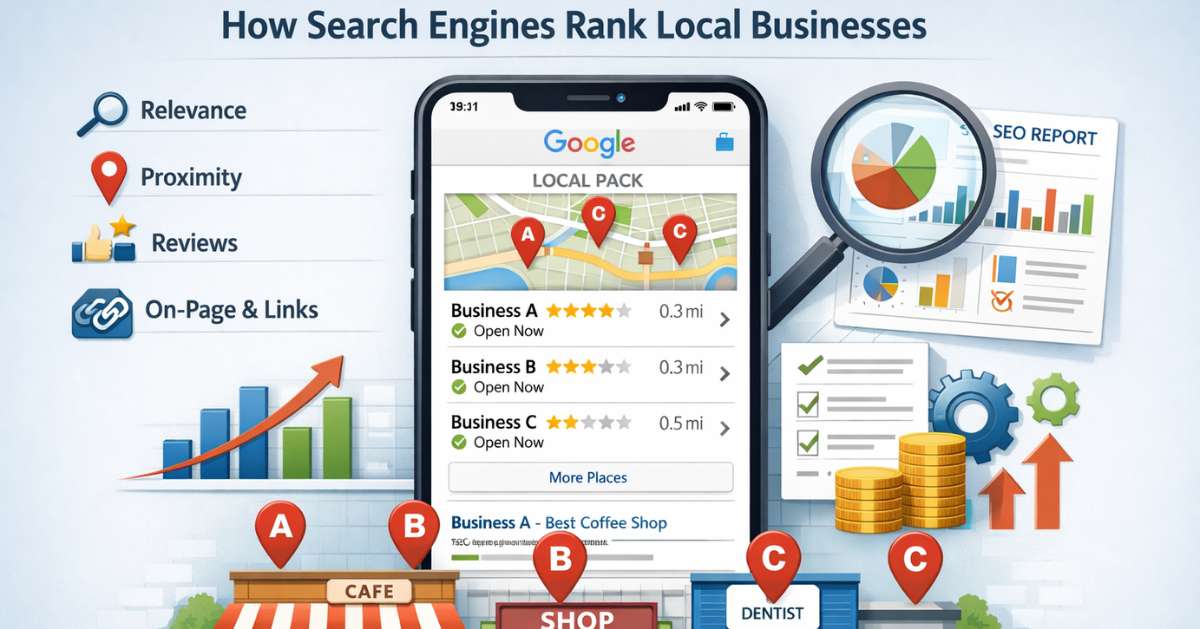
In today’s digital-first world, customers rely heavily on search engines to find nearby businesses. Whether someone searches for “best salon near me” or “digital marketing agency in Hyderabad,” search engines instantly decide which businesses deserve top visibility. But have you ever wondered how search engines decide local rankings?
Understanding this process is essential for any business investing in a local SEO service, because rankings directly impact calls, visits, and sales. In this guide, we’ll break down the exact factors search engines use to rank local businesses—and how you can optimize for them.
What Are Local Search Rankings?
Local search rankings determine which businesses appear in Google Maps and the Local Pack when users search for services in a specific location. These results are different from traditional organic rankings because they focus on geographic relevance.
For example, if someone searches for “plumber near me,” Google prioritizes businesses closest to the user that are trustworthy and relevant. This is where a professional local SEO service plays a critical role in improving visibility.
The Three Core Local Ranking Factors
Search engines like Google officially confirm that three primary factors decide local rankings:
- Relevance
- Distance
- Prominence
Let’s explore each in detail.
1. Relevance: Matching Search Intent
Relevance refers to how closely a business matches what the user is searching for.
Search engines analyze:
- Business category
- Services listed
- Website content
- Keywords used
- Google Business Profile details
If your business profile clearly explains what you offer, search engines can easily match you with relevant searches.
2. Distance: Location Proximity Matters
Distance measures how close your business is to the searcher’s location.
If a user doesn’t specify a location (like a city name), search engines calculate distance based on:
- User’s GPS location
- IP address
- Search history
You can’t control where users search from—but you can optimize location signals such as:
- Accurate address
- Embedded Google Maps
- Location-based keywords
3. Prominence: Authority and Trust Signals
Prominence reflects how well-known and trusted your business is—both online and offline.
Search engines measure prominence using:
- Online reviews
- Ratings
- Backlinks
- Citations
- Brand mentions
Businesses with strong digital authority are more likely to rank higher—even if they’re slightly farther away.
Role of Google Business Profile in Local Rankings
Your Google Business Profile (GBP) is the foundation of local SEO.
Search engines evaluate:
- Profile completeness
- Business category accuracy
- Keywords in description
- Photos and videos
- Regular updates and posts
An optimized GBP significantly boosts local visibility. Most professional local SEO service providers start optimization from here.
[Also Read: How Local Citations Impact Google Maps Ranking]
Online Reviews and Ratings: Social Proof for Rankings
Reviews directly influence both rankings and conversions.
Search engines analyze:
- Number of reviews
- Review frequency
- Keywords in reviews
- Response activity
- Overall rating
Businesses with consistent, positive reviews rank higher and attract more clicks.
NAP Consistency: Trust Through Accuracy
NAP stands for:
- Name
- Address
- Phone Number
Search engines cross-check your NAP details across:
- Business directories
- Social profiles
- Websites
- Maps listings
Even small inconsistencies can confuse algorithms and lower rankings. A reliable local SEO service performs regular citation audits to maintain accuracy.
Website Optimization and Local SEO Signals
Your website plays a huge role in local rankings.
Important website signals include:
- Location-based keywords
- Mobile responsiveness
- Fast page speed
- Local landing pages
- Schema markup
Search engines favor websites that provide clear local relevance and excellent user experience.
Backlinks and Local Authority
Backlinks from relevant and local websites boost prominence.
High-quality links may come from:
- Local news portals
- Business associations
- Local blogs
- Event sponsorships
A strategic local SEO service focuses on earning geo-relevant backlinks, not just generic links.
Behavioral Signals: How Users Interact
Search engines track user behavior such as:
- Click-through rate
- Direction requests
- Phone calls
- Time spent on website
If users frequently interact with your listing, search engines see it as a sign of relevance and quality. This is why conversion-focused optimization is part of advanced local SEO service strategies.
Mobile Optimization and Voice Search
With most local searches happening on mobile, search engines prioritize:
- Mobile-friendly websites
- Fast loading speed
- Easy navigation
Voice search also plays a growing role, especially for “near me” queries. Optimizing conversational keywords helps improve rankings.
How a Local SEO Service Helps Improve Rankings
Managing all these factors manually is complex. A professional local SEO service helps by:
- Optimizing Google Business Profile
- Performing local keyword research
- Managing reviews and citations
- Building local backlinks
- Tracking rankings and analytics
This ensures long-term visibility and consistent lead generation.
Final Thoughts
Search engines decide local rankings based on relevance, distance, and prominence, supported by reviews, website optimization, backlinks, and user behavior. Businesses that understand and optimize these factors consistently outperform competitors. If your goal is to attract nearby customers, investing in a reliable local SEO service is no longer optional—it’s essential. By aligning your business with how search engines evaluate local results, you don’t just rank higher—you grow faster.