


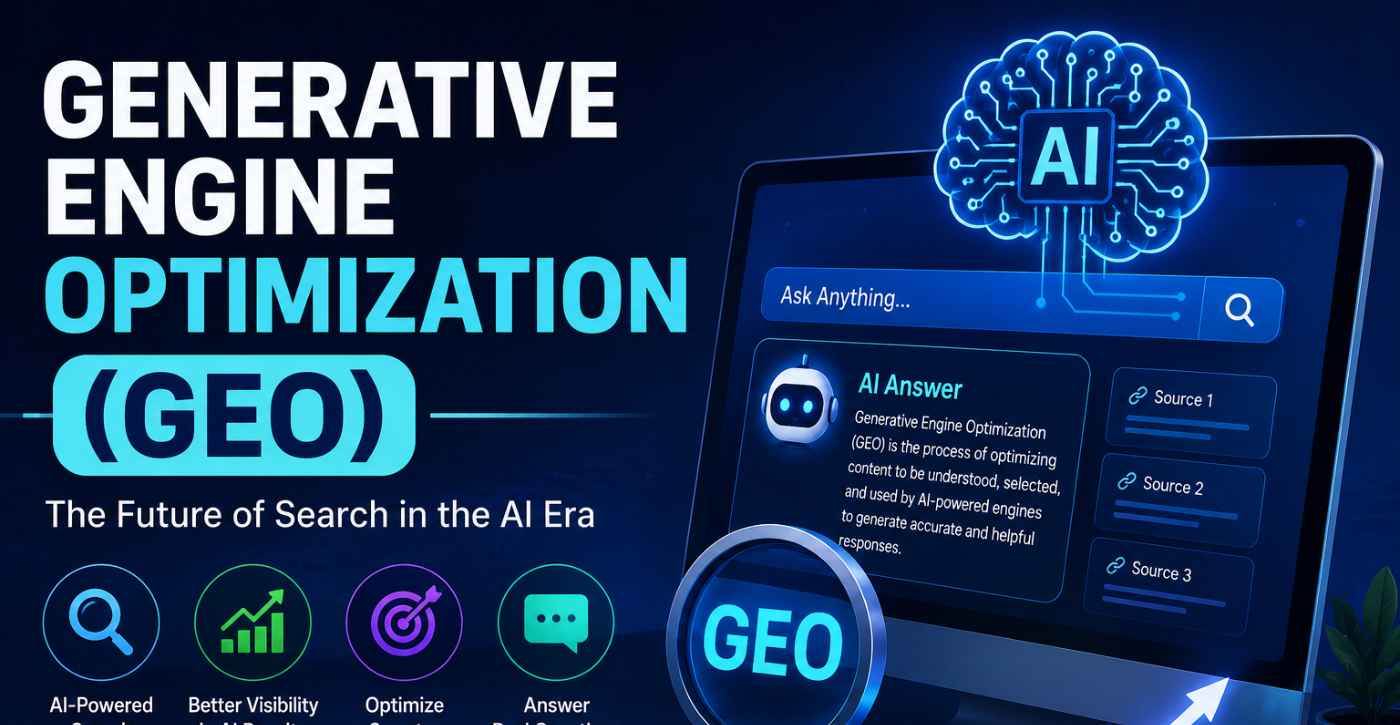
The digital landscape is rapidly evolving, and so is the way people search for information online. Traditional search engines are no longer the only gateways to knowledge. With the rise of artificial intelligence tools like ChatGPT, Google Gemini, and other generative AI platforms, a new concept has emerged: Generative Engine Optimization (GEO).
GEO is transforming how content is created, optimized, and discovered. As businesses and marketers adapt to this shift, understanding GEO becomes essential for staying competitive in the modern digital ecosystem.
What is Generative Engine Optimization (GEO)?
Generative Engine Optimization (GEO) refers to the process of optimizing digital content so it can be effectively understood, selected, and presented by AI-powered generative engines. Unlike traditional SEO, which focuses on ranking web pages in search engine results pages (SERPs), GEO focuses on making content accessible and valuable for AI systems that generate direct answers.
These AI engines don’t just list links—they synthesize information from multiple sources to deliver conversational responses. Therefore, GEO ensures your content becomes part of those responses.
GEO vs SEO: Key Differences
While SEO and GEO share common goals—visibility and traffic—their approaches differ significantly.
- Search Behavior: SEO targets keyword-based queries, while GEO focuses on natural language and conversational prompts.
- Content Presentation: SEO delivers ranked links, whereas GEO provides summarized answers generated from various sources.
- Optimization Strategy: SEO relies heavily on backlinks, keywords, and technical factors. GEO emphasizes content clarity, authority, and contextual relevance.
- User Intent: GEO prioritizes deeper understanding of user intent, including context and follow-up queries.
Why GEO Matters in 2026 and Beyond
The adoption of generative AI tools is increasing at an unprecedented rate. Users now prefer asking questions directly to AI rather than browsing multiple websites. This shift has several implications:
- Reduced Click Dependency: Users may get answers without visiting websites.
- Content Visibility Shift: Only high-quality, authoritative content gets selected by AI.
- New Traffic Channels: AI-generated responses become a new source of traffic.
Businesses that ignore GEO risk losing visibility in this evolving search landscape.
How Generative Engines Work
Generative engines use advanced language models trained on vast datasets. When a user asks a question, the AI:
- Understands the intent behind the query
- Retrieves relevant information from its training data or connected sources
- Synthesizes the information into a coherent response
- Delivers a conversational answer
This process means your content must be structured and informative enough for AI to extract and trust it.
Core Principles of GEO
To succeed in GEO, content creators must follow these key principles:
- Create High-Quality, Authoritative Content: Content must be accurate, well-researched, and trustworthy. AI systems prioritize credible sources.
- Focus on Context and Intent: Write content that answers real user questions clearly and comprehensively.
- Use Structured Content: Organize your content using headings, bullet points, and clear sections to help AI understand it better.
- Optimize for Conversational Queries: Include natural language phrases and question-based headings like What is GEO? and How does GEO work?
5. Build Topical Authority: Cover topics in-depth to establish your website as a reliable source.
GEO Content Optimization Strategies
- Answer-Based Content Creation: Write content that directly answers questions. Use clear and concise explanations.
- Semantic SEO Integration: Use related terms and concepts to provide context instead of focusing only on keywords.
- Featured Snippet Optimization: Although GEO goes beyond snippets, structured answers still improve AI visibility.
- Use Data and Examples: Include statistics, case studies, and real-world examples to enhance credibility.
- Update Content Regularly: AI systems prefer fresh and updated information.
The Role of E-E-A-T in GEO
E-E-A-T stands for Experience, Expertise, Authoritativeness, and Trustworthiness. These factors are critical in GEO because AI systems prioritize reliable sources.
- Experience: Demonstrate firsthand knowledge
- Expertise: Show subject matter expertise
- Authority: Build recognition in your niche
- Trust: Provide accurate and verifiable information
Content that meets these criteria is more likely to be used by generative engines.
Challenges in Generative Engine Optimization
While GEO offers exciting opportunities, it also comes with challenges:
- Reduced Website Traffic: Users may not click through if AI provides complete answers.
- Content Attribution Issues: AI-generated responses may not always credit the original source.
- Constant Algorithm Changes: Generative models evolve rapidly, requiring continuous adaptation.
- Increased Competition: Only the best content gets selected, making quality more important than ever.
Future Trends in GEO
The future of GEO is closely tied to advancements in AI. Some key trends include:
- AI Search Integration: Traditional search engines integrating generative AI
- Voice Search Growth: More conversational queries through voice assistants
- Personalized Responses: AI delivering tailored answers based on user behavior
- Multimodal Content: Integration of text, images, and videos in AI responses
Businesses must prepare for these trends to remain visible.
Best Practices for GEO Success
To maximize your GEO strategy, follow these best practices:
- Write for humans first, AI second
- Focus on clarity and simplicity
- Use question-based formats
- Provide in-depth explanations
- Build strong content authority
- Optimize for multiple search platforms
- Monitor AI-driven traffic sources
[Also Read: Best OTT Advertising Platforms for Indian Businesses]
Conclusion
Generative Engine Optimization (GEO) represents the next evolution of digital marketing. As AI-powered search continues to grow, businesses must adapt their content strategies to remain relevant.
By focusing on high-quality, structured, and user-focused content, you can ensure your website becomes a trusted source for generative engines. GEO is not replacing SEO—it is enhancing it. Together, they form a powerful approach to digital visibility in the AI-driven future.
Now is the time to embrace GEO and position your brand at the forefront of the next search revolution.