


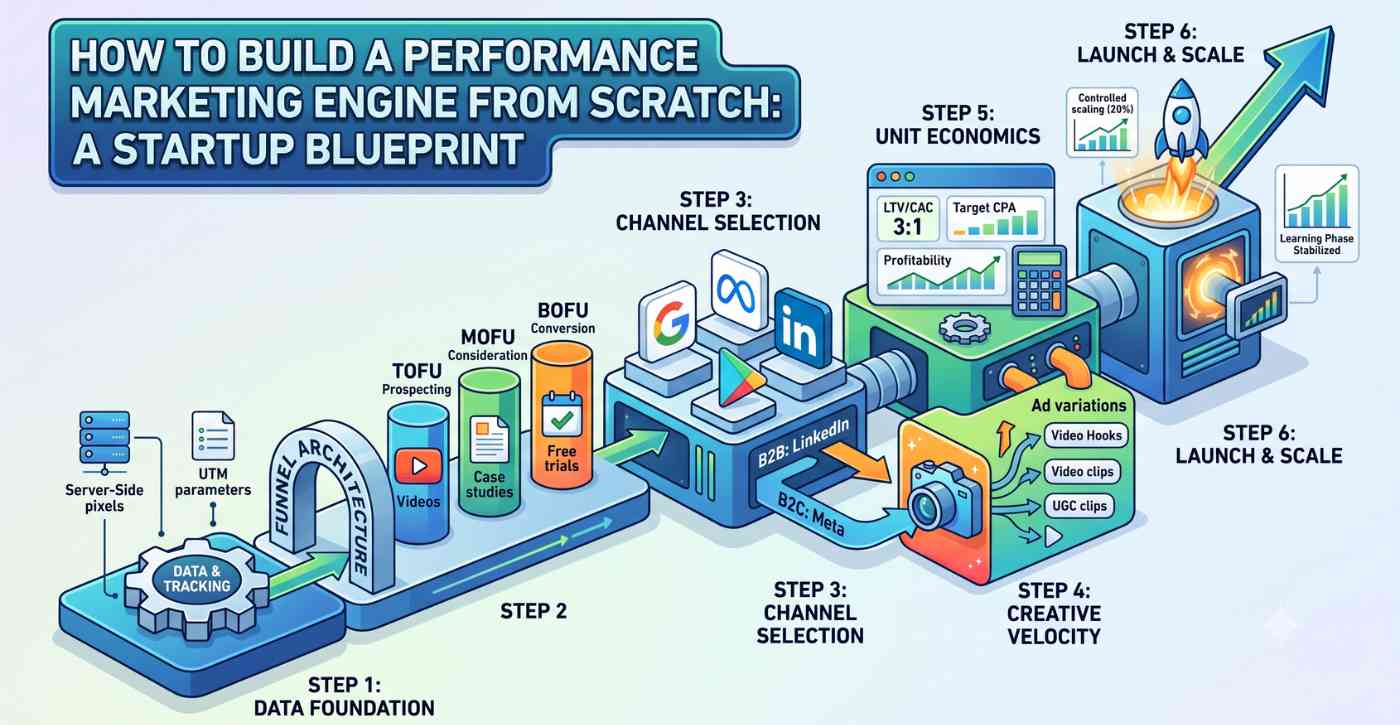
For growth-stage startups, the luxury of “burning capital for brand awareness” is long gone. When every dollar counts, your marketing cannot afford to be vague. You need an engine where $1 put in yields a predictable, measurable return in revenue.
That is the essence of performance marketing: a data-driven strategy where campaign execution is tied directly to measurable outcomes like clicks, leads, acquisitions, or sales.
Building this framework from the ground up can feel overwhelming. If you plug money into ad platforms without a solid foundation, you will essentially just donate cash to Meta and Google. This step-by-step blueprint will help your growth-stage startup build a high-performing marketing engine from scratch.
Step 1: Audit and Align Your Data Infrastructure
Before you write a single line of ad copy or set a budget, you must ensure your tracking is flawless. In performance marketing, if you cannot measure it, it didn’t happen.
Most startups fail here because they rely on broken pixels or mismatched attribution tools.
-
Implement Server-Side Tracking: Browser-based cookies are heavily restricted. Set up Server-Side tracking (like Meta Conversions API or Google Cloud Taging) alongside standard browser pixels to ensure accurate data delivery.
-
Establish a Clean UTM Framework: Standardize your URL parameters. If your team uses
utm_source=facebookon one link andutm_source=FBon another, your analytics platform will treat them as entirely different channels, ruining your data integrity. -
Define Your Single Source of Truth: Decide early on which platform dictates success. Will you rely on Google Analytics 4 (GA4), a backend CRM like HubSpot/Salesforce, or an internal data warehouse?
Step 2: Define Content and Funnel Architecture
A common pitfall is treating performance marketing like a giant billboard, blasting bottom-of-funnel “Buy Now” messages to cold audiences. A sustainable engine addresses users at every stage of their decision-making process.
       ▲  [TOFU] Top of Funnel: Problem Awareness & Education
      ╱ ╲ (Videos, Informative Blogs, Infographics)
     ╱   ╲
    ╱     ╲ [MOFU] Middle of Funnel: Solution Comparison
   ╱       ╲ (Case Studies, Comparison Guides, Free Tools)
  ╱         ╲
 ╱           ╲ [BOFU] Bottom of Funnel: Conversion Activation
/_____________\ (Free Trials, Demos, Retargeting Discount Offers)
To build a balanced system, divide your campaigns into three distinct layers:
-
Top of Funnel (TOFU) – Prospecting: Introduce your startup to cold audiences. Focus on their pain points, not your features.
-
Middle of Funnel (MOFU) – Consideration: Engage users who have interacted with your brand but haven’t bought yet. Show them comparison guides, customer testimonials, or whitepapers.
-
Bottom of Funnel (BOFU) – Retargeting: Target high-intent users who abandoned a cart or signed up for a trial but didn’t convert. Offer specific nudges like a live demo, a limited-time discount, or an explicit ROI calculator.
Step 3: Choose Your Primary Channels Wisely
Growth-stage startups rarely have the bandwidth or budget to succeed on five different platforms simultaneously. It is much better to dominate one or two channels than to be completely invisible on five.
Select your initial channels based entirely on your business model:
| Business Model | Primary Channel Fit | Core Focus |
| B2B SaaS / Fintech | LinkedIn Ads & Google Search | Capturing high-intent searchers and targeting specific professional roles/company sizes. |
| B2C / E-commerce | Meta Ads (Instagram/Facebook) & TikTok | Visual storytelling, pattern-interrupting video creative, and leveraging algorithmic interest targeting. |
| Niche Products | Google Shopping & Intent-based Search | Matching immediate consumer demand when user intent is highest. |
Start with one intent-based channel (like Google Search, to capture people actively looking for a solution) and one interruption-based channel (like Meta, to generate demand among people who don’t know you exist yet).
Step 4: Develop a “Creative Velocity” Framework
In modern performance marketing, ad targeting is largely handled by machine learning algorithms. You no longer need to micro-manage hyper-specific interest groups; the algorithm figures out who likes your product based on how they interact with your ad.
Because the algorithm relies on the ad itself to find your audience, creative is your targeting.
To prevent creative fatigue—where your target audience gets tired of seeing the same ad and your cost-per-acquisition (CPA) spikes—you must build a content production machine.
-
The Hook-Body-CTA Method: For video or static assets, isolate your variables. Test three completely different 3-second “hooks” (the opening line or visual) with the exact same video body and call to action. This allows you to find winning variations without shooting entirely new concepts every week.
-
Leverage User-Generated Content (UGC): Authentic, raw, phone-shot videos from real customers or creators frequently outperform polished, expensive studio productions on paid social channels.
Step 5: Master the Unit Economics of Bidding
You cannot run profitable performance marketing campaigns if you don’t know your numbers. Before allocating a budget, map out your core financial metrics:
-
Customer Lifetime Value (LTV): How much gross profit does a customer generate over their entire relationship with your startup?
-
Customer Acquisition Cost (CAC): The total sales and marketing spend required to acquire a single customer.
-
The LTV:CAC Ratio: A healthy growth-stage startup generally aims for an LTV:CAC ratio greater than 3:1.
Once you know your target CAC, you can calculate your Maximum Allowed CPA on your ad networks. If your product sells for $100 and your margins allow for a $30 acquisition cost, your campaigns must be optimized to hit that threshold or lower to sustain profitability.
Step 6: Launch, Learn, and Scale Safely
When you launch your campaigns, give the platforms enough budget and time to exit the “learning phase.” The ad platform’s AI needs a baseline number of conversions (typically around 50 per week per ad set) to stabilize its targeting.
-
Do Not Touch Active Campaigns: Making major edits to budgets, bids, or creative assets every two days resets the algorithm’s learning phase, resulting in volatile performance and wasted spend.
-
The 20% Scaling Rule: When you find a winning campaign, do not double the budget overnight. This shocks the algorithm. Instead, increase the budget by 15% to 20% every 3 to 4 days to scale smoothly while keeping your CPA stable.
Also Read: Best OTT Advertising Platforms for Indian Businesses
Summary Checklist for Startups
Building a performance marketing engine is an iterative process. Focus on getting your tracking and data right first, build a steady stream of creative variations, and ruthlessly cut underperforming elements based on cold, hard data. By shifting your focus from vanity metrics (like impressions and likes) to true revenue metrics, your growth-stage startup can build a predictable, scalable acquisition engine.